Comprehensive Interpretation of the Latest VW80000 Standard in 2026 | Core Norms for Volkswagen's On-board Electronic and Electrical Access Requirements
 Data:2026-04-28
 Click:1788


Data:2026-04-28
Click:1788
Preface
With the rapid popularization of automotive electronics and intelligence, the reliability of electronic and electrical components such as on-board sensors, controllers, wiring harnesses, and ECUs directly determines the safety and service life of the entire vehicle. VW80000 is the most core and widely applied general access standard for on-board electronic and electrical components of the Volkswagen Group. It is also a hard threshold for domestic automotive electronic suppliers to enter the supply chain of the Volkswagen, Audi, Skoda and other groups.
I. Overview of VW80000 Standard Basics
1.1 Official Standard Positioning
VW80000: A corporate standard of the Volkswagen Group, with the full title "General Requirements, Test Conditions and Test Methods for Electrical, Electronic and Electromechanical Components of Motor Vehicles under 3.5 Tons".
The current mainstream version is VW80000:2022-12 (the latest updated version), which was preceded by VW80101. It is an optimized and upgraded version based on the European joint automaker LV124 specification. The framework was jointly formulated by Volkswagen, Audi, BMW, Mercedes-Benz, and Porsche, with Volkswagen independently implementing it.
1.2 Scope of Application
Applicable: All 12V low-voltage on-board electronic and electrical/mechanical components of passenger cars and light commercial vehicles with a total mass of ≤ 3.5t, including sensors, ECU controllers, actuators, on-board wiring harnesses, on-board modules, LIN/CAN bus devices, etc., from first and second-tier suppliers.
Not applicable: High-voltage new energy components (refer to Volkswagen's high-voltage specific standards), vehicle-level system testing, software functional safety (refer to VW10101/ISO26262), special vehicle-mounted equipment for military and aerospace, and non-Volkswagen-matched parts.
Mandatory requirement: All supporting suppliers of Volkswagen Group must pass the compliance test. Those who fail to meet the standards are prohibited from supplying parts for installation on vehicles and from providing supplies.
1.3 Two Major Modules of the Standard as a Whole
The VW80000 is divided into two independent parts as a whole, covering the full-dimensional verification of electrical performance and environmental durability.
Part One: Electrical Performance Requirements and Electrical Testing for 12V Vehicle Power Grid (E Series Testing)
Covering all electrical conditions such as vehicle start-up, shutdown, voltage fluctuations, transient interference, and abnormal grid conditions is the core of the standard.
Part Two: Environmental, Mechanical, and Climatic Durability Requirements and Testing
It includes physical reliability verification such as high and low temperatures, damp heat, vibration, shock, corrosion, and durability of service life.
II. VW80000 Core Electrical Test (E Series)
The most complex issue for the vehicle power grid is not maintaining a stable power supply, but rather abnormal conditions such as start-up voltage drop, load rejection, transient overvoltage, voltage sag, voltage interruption, and ripple superposition. VW80000 has quantified all risks of the vehicle power grid into standardized test items (E01 to E24).
Core Electrical Test Items
E01 Long-term Overvoltage Test
Simulate the abnormal high-voltage continuous power supply of the vehicle-mounted generator to verify that the components can withstand high voltage for a long time without damage or malfunction.
E02 Transient Overvoltage
The ability to resist instantaneous high-voltage pulses generated by analog circuit switches, static electricity, and interference.
E03 Transient Undervoltage
Voltage drops momentarily when vehicles idle or high-power electrical equipment starts up, and components must not freeze, restart or fail in function.
E04 Jump Start (Cross-Start)
In the scenario of jump-starting due to a depleted battery, simulate high-voltage surges to verify the interface and circuit protection capabilities.
E05 Load Dump (Sudden Load Reduction)
The sudden disconnection of the vehicle battery and the no-load operation of the generator represent the most severe electrical shock in a vehicle and are also key assessment items in VW80000.
E06 Superimpose AC ripple voltage
The generator outputs direct current with alternating current ripple. Verify the power supply filtering and the circuit's anti-ripple capability.
E07~E13: Slow voltage rise and fall, rapid voltage rise and fall, reset characteristics, short-term power interruption, start pulse, grid voltage regulation fluctuation, pin open circuit and other working condition tests.
Function determination level
The standard defines five functional states from A to E, and the entire testing process is monitored.
A: The function is completely normal (qualified).
B/C: Slight performance degradation, recoverable
D: Abnormal function but can recover automatically
E: Permanently damaged, requires repair or replacement (unqualified)
III. VW80000 Environmental & Mechanical Durability Requirements
In addition to electrical immunity, the standard also requires components to be adaptable to harsh environments throughout the entire life cycle of the vehicle.
High and low temperature cycling: high-temperature operation, low-temperature storage, and thermal shock, covering -40℃ to 85℃ and above vehicle operating conditions.
Moisture and heat resistant for long-term use: Anti-condensation and anti-moisture aging
Vibration / Mechanical Shock: Simulating road bumps and engine vibration durability
Corrosion protection: salt spray, chemical corrosion (oil stains inside the vehicle, acids and alkalis)
Service life: The standard requires a design life of 15 years, 8,000 hours of effective working time, and durability verification for 300,000 kilometers of vehicle mileage.
IV. Comparison between VW80000, LV124 and National Standard GB/T28046
Many engineers confuse the three, and this article clearly distinguishes them.
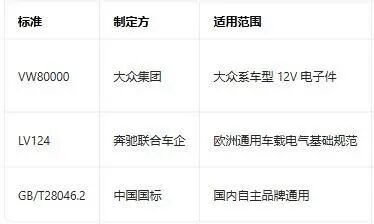
Domestic self-owned brands such as SAIC, Geely and BAIC are currently all referring to the VW80000 electrical test logic to enhance the reliability of components.
V. Key Points for the Implementation of Supplier Compliance
During the new product development stage, it is essential to design power protection, port circuits, and reset logic in advance in accordance with VW80000 standards. Do not make rectifications after mass production.
2. Electrical tests must be carried out in the standard sequence: normal temperature functional self-check → item-by-item electrical testing → environmental durability → retest of functions.
3. Test reports, data traceability, and rectification records must be fully retained for random checks by Volkswagen at any time.
4. Distinguish between the electrical test of VW80000 and EMC electromagnetic compatibility: They are independent standards and both need to be met separately.
VI. Conclusion
VW80000 is not merely a test standard; it is the fundamental access rule for the reliability of Volkswagen's in-vehicle electronic and electrical systems. It transforms the complex, random, and harsh in-vehicle power grid environment into a unified specification that is quantifiable, testable, and implementable, ensuring the electrical safety and stability of the entire vehicle while also regulating the entire process of development, testing, and quality control for suppliers.
For practitioners in the automotive electronics industry, thoroughly understanding VW80000 is an essential skill for entering the supply chain of European car manufacturers and enhancing the competitiveness of domestic components.